Showing posts with label Poet Biography. Show all posts

Wednesday, May 23, 2007

The Moon by Sappho


The above is a fragment of a poem by the Greek poetess Sappho. (Click on it to see it better!) You'll love what happens when several poets try their hand at translating this lovely piece:

THE stars about the lovely moon
Fade back and vanish very soon,
When, round and full, her silver face
Swims into sight, and lights all space
Edwin Arnold

The stars around the lovely moon
Their radiant visage hide as soon
As she, full-orbed, appears to sight,
Flooding the earth with her silvery light.
Felton?

Planets, that around the beauteous moon
Attendant wait, cast into shade
Their ineffectual lustre, soon
As she, in full-orbed majesty arrayed,
Her silver radiance pours
Upon this world of ours.
John Hermann Merivale

The stars about the fair moon in their turn hide their bright face when she at about her full lights up all earth with silver.
H.T. Wharton

Stars that shine around the refulgent full moon
Pale, and hide their glory of lesser lustre
When she pours her silvery plenilunar
Light on the orbed earth.
J. A. Symonds

Awed by her brightness
Stars near the beautiful moon
Cover their own shining faces
When she lights earth
With her silver brilliance
Of love ....
D.W. Myatt

The moon rose full,
and as around an altar, stood the women.
J.B. Hare

Now rose the moon, full and argentine,
While round stood the maidens, as at a shrine.
Edward Marion Cox

Awed by her splendor
stars near the lovely
moon cover their own
bright faces
when she
is roundest and lights
earth with her silver
Mary Barnard


Sappho of Lesbos

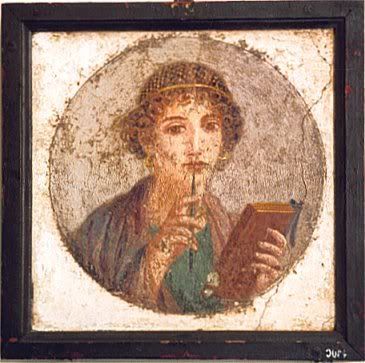
Sappho, a poet of ancient Greece, is known through her work: ten books of verse published by the third and second centuries B.C.E. By the Middle Ages, all copies were lost. Today what we know of the poetry of Sappho is only through quotations in the writings of others. Only one poem from Sappho survives in complete form, and the longest fragment of Sappho poetry is only 16 lines long.

The poems of Sappho are more personal and emotional than political or civic or religious, especially compared to her contemporary, the poet Alcaeus.

Sappho lived in Mytilene on the island of Lesbos, where women often congregated and, among other social activities, shared poetry they'd written. Sappho's poems usually focus on the relationships among women.

Follow this link for some wonderful images from the Sappho Art Museum.

Tuesday, May 22, 2007

Choose Something Like a Star

Choose Something Like a Star
by Robert Frost - 1947

O Star (the fairest one in sight),
We grant your loftiness the right
To some obscurity of cloud --
It will not do to say of night,
Since dark is what brings out your light.
Some mystery becomes the proud.
But to be wholly taciturn
In your reserve is not allowed.

Say something to us we can learn
By heart and when alone repeat.
Say something! And it says "I burn."
But say with what degree of heat.
Talk Fahrenheit, talk Centigrade.
Use language we can comprehend.
Tell us what elements you blend.

It gives us strangely little aid,
But does tell something in the end.
And steadfast as Keats' Eremite,
Not even stooping from its sphere,
It asks a little of us here.
It asks of us a certain height,
So when at times the mob is swayed
To carry praise or blame too far,
We may choose something like a star
To stay our minds on and be staid.


This poem has been one of my favorites since the time a choral group I belonged to sang Frostiana.

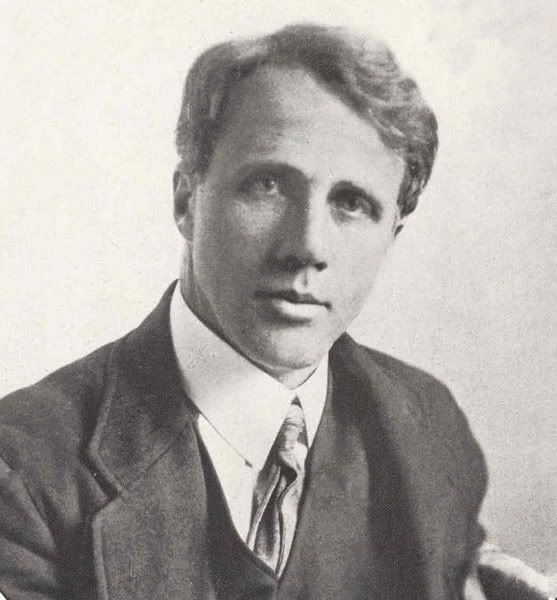
The following biographical information on Robert Frost was taken from poets.org. And check out the pic! He's actually a pretty good-looking guy!

Robert Frost was born in San Francisco in 1874. He moved to New England at the age of eleven and became interested in reading and writing poetry during his high school years in Lawrence, Massachusetts. He was enrolled at Dartmouth College in 1892, and later at Harvard, though he never earned a formal degree.

Frost drifted through a string of occupations after leaving school, working as a teacher, cobbler, and editor of the Lawrence Sentinel. His first professional poem, "My Butterfly," was published on November 8, 1894, in the New York newspaper The Independent.

In 1895, Frost married Elinor Miriam White, who became a major inspiration in his poetry until her death in 1938. The couple moved to England in 1912, after their New Hampshire farm failed, and it was abroad that Frost met and was influenced by such contemporary British poets as Edward Thomas, Rupert Brooke, and Robert Graves. While in England, Frost also established a friendship with the poet Ezra Pound, who helped to promote and publish his work.

By the time Frost returned to the United States in 1915, he had published two full-length collections, A Boy's Will and North of Boston, and his reputation was established. By the nineteen-twenties, he was the most celebrated poet in America, and with each new book—including New Hampshire (1923), A Further Range (1936), Steeple Bush (1947), and In the Clearing (1962)—his fame and honors (including four Pulitzer Prizes) increased.

Though his work is principally associated with the life and landscape of New England, and though he was a poet of traditional verse forms and metrics who remained steadfastly aloof from the poetic movements and fashions of his time, Frost is anything but a merely regional or minor poet. The author of searching and often dark meditations on universal themes, he is a quintessentially modern poet in his adherence to language as it is actually spoken, in the psychological complexity of his portraits, and in the degree to which his work is infused with layers of ambiguity and irony.

In a 1970 review of The Poetry of Robert Frost, the poet Daniel Hoffman describes Frost's early work as "the Puritan ethic turned astonishingly lyrical and enabled to say out loud the sources of its own delight in the world," and comments on Frost's career as The American Bard: "He became a national celebrity, our nearly official Poet Laureate, and a great performer in the tradition of that earlier master of the literary vernacular, Mark Twain."

About Frost, President John F. Kennedy said, "He has bequeathed his nation a body of imperishable verse from which Americans will forever gain joy and understanding."

Robert Frost lived and taught for many years in Massachusetts and Vermont, and died in Boston on January 29, 1963.

A great link to Frost's poems is found at Robert Frost: America's Poet. I recommend that you spend a few minutes browsing this site and reading some more of his poetry.

Wednesday, May 16, 2007

Henry Howard, Earl of Surrey

Henry Howard was born in 1517 in Hertfordshire, England. He was the oldest son of Thomas Howard, 3rd Duke of Norfolk, and Lady Elizabeth Stafford, and so was descended from kings on both sides of the family. He was educated at Windsor Castle, the British royal residence with Henry Fitzroy, King Henry VIII's illegitimate son, who later married his sister. Thus he was brought up in all the virtues and practices of chivalry, which find a large place in his poems. He continually bragged of his royal descent and thus was imprisoned on several occasions. Once he was charged with breaking windows in the city with a crossbow, to which he answered that he was “a figure of the Lord’s behest,” sent to warn the sinful city of her doom. Henry was eventually convicted of treason, and executed January 13, 1547.

Henry Howard introduced blank verse to English in translating two books of Virgil's Aeneid. Along with his friend Sir Thomas Wyatt, he adapted and popularized Petrarch's Italian sonnet form, bringing it over into English. Wyatt's and Surrey's poems were among the first lyrics from the courtiers' manuscript tradition to find their way into mass-production print in the form of the poetry collection traditionally called "Tottel's Miscellany" (1557).

Surrey was held in great literary esteem. The following is an example of a sonnet written by Surrey and published in the Miscellany.


Love that doth reign and live within my thought
And built his seat within my captive breast,
Clad in the arms wherein with me he fought,
Oft in my face he doth his banner rest.
But she that taught me love and suffer pain,
My doubtful hope and eke my hot desire
With shamefast look to shadow and refrain,
Her smiling grace converteth straight to ire.
And coward Love then to the heart apace
Taketh his flight, where he doth lurk and plain
His purpose lost, and dare not show his face.
For my lord's guilt thus faultless bide I pain;
Yet from my lord shall not my foot remove:
Sweet is the death that taketh end by love.