Showing posts with label Weekly Writing Challenge. Show all posts

Thursday, July 5, 2007

Weekly Writing Challenge--The Clerihew

Here's another poetic form I've never tried, but it sounds like a lot of fun! The clerihew is very simple. It is about a person. It is funny. It is four lines long, the first and second lines rhyme, and the third and fourth lines rhyme.

This form was invented by Edmund Clerihew Bentley, and is named after him. While he was a student, he began writing these humorous poems about the people he was studying. They were a great hit with his friends! The first Clerihew ever written was this:

Sir Humphry Davy
Detested gravy.
He lived in the odium
Of having discovered sodium.

Another one of Bentley's is this:

Daniel Defoe
Lived a long time ago.
He had nothing to do, so
He wrote Robinson Crusoe.

Here's a final example I came across that I found particularly amusing:

N'Sync
Stink.
Their music hurts my ears.
I much prefer Britney Spears.

Tuesday, June 26, 2007

Weekly Writing Challenge--Octameter

I love playing with meter. I think it is fascinating that different languages seem to lend themselves to certain meters. For example, in English, the most common meter used in poetry is iambic pentameter - each line containing five metrical feet.

The badger grunting on his woodland track
With shaggy hide and sharp nose scrowed with black
(John Clare, The Badger)

In other languages, meter can be quite different. The modern French language does not have a significant stress accent (like English) or long and short syllables (like Latin). This means that the French metric line is generally not determined by the number of beats, but by the number of syllables. In the Renaissance, there was a brief attempt to develop a French poetics based on long and short syllables. The most common metric lengths are the ten-syllable line ("décasyllabe"), the eight-syllable line ("octosyllabe") and the twelve-syllable line (the so-called "alexandrin").

Our weekly challenge is to write a staza of poetry in octameter--lines of eight metrical feet. Though this meter is more common in the French language, there have been a few superb examples of octameter in English:

Once upon a midnight dreary, while I pondered, weak and weary
Over many a quaint and curious volume of forgotten lore-
While I nodded, nearly napping, suddenly there came a tapping
As of some one gently rapping, rapping at my chamber door.
(Edgar Allan Poe, "The Raven")

(Note especially the second line.) Doesn't that sound great? Let's try it!

*

Sunday, June 17, 2007

Weekly Writing Challenge--Haiku

Writing haiku is wonderfully relaxing. (I need to take it easy after all that hard work on the sestina.) I don't know what it is about the combination of 5, 7, and 5 phonetic units that is so serene and peaceful. But you'll notice that writing haiku is good for the soul.

I discovered that there is a difference between the original Japanese form of haiku poetry and the Western version. In Japanese, the haiku contains a special season word (kigo) representative of the season in which the poem is set, or a reference to the natural world. The three different phases are signaled by grammatical breaks, and the poem is written all in one line. In English, we generally separate the poem into three lines.

I'll get you started with two beautiful representative poems. The first is translated from an "old master" Japanese poet. The second is a more modern, urban haiku.

Temple bells die out.
The fragrant blossoms remain.
A perfect evening!
--Matsuo Basho

Freeway overpass
Blossoms in grafitti on
fog-wrapped June mornings
--Michael R. Collings

Wednesday, June 6, 2007

Weekly Writing Challenge--The Sestina

The Sestina is one of the more challenging forms of poetry. I've been trying to write one for quite a while now, with little success. But I hope this public forum will inspire me to really work on it this week!

This poem is made up of seven stanzas, the first six of which have six lines, the seventh having only three. There is a very exact pattern to the sestina's stanzas.

The first stanza is the defining stanza, and the six words that are used to end each line are the defining words, as they will be repeated throughout the rest of the poem.

In this template, each letter represents the ending word of a line:

a b c d e f (first stanza)
f a e b d c (second stanza)
c f d a b e (third stanza)
e c b f a d (fourth stanza)
d e a c f b (fifth stanza)
b d f e c a (sixth stanza)
a d (1st line of the 7th stanza, "a" must be in the line, but the line must end with "d")
b e (2nd line of the 7th stanza, "b" must be in the line, but the line must end with "e")
c f (3rd line of the 7th stanza, "c" must be in the line, but the line must end with "f")

Let me illustrate with a sample. The following is "Sestina of the Tramp" by Rudyard Kipling:

Speakin' in general, I'ave tried 'em all
The 'appy roads that take you o'er the world.
Speakin' in general, I'ave found them good
For such as cannot use one bed too long,
But must get 'ence, the same as I'ave done,
An' go observin' matters till they die.

What do it matter where or 'ow we die,
So long as we've our 'ealth to watch it all
The different ways that different things are done,
An' men an' women lovin' in this world;
Takin' our chances as they come along,
An' when they ain't, pretendin' they are good?

In cash or credit no, it aren't no good;
You've to 'ave the 'abit or you'd die,
Unless you lived your life but one day long,
Nor didn't prophesy nor fret at all,
But drew your tucker some'ow from the world,
An' never bothered what you might ha' done.

But, Gawd, what things are they I'aven't done?
I've turned my 'and to most, an' turned it good,
In various situations round the world
For 'im that doth not work must surely die;
But that's no reason man should labour all
'Is life on one same shift life's none so long.

Therefore, from job to job I've moved along.
Pay couldn't 'old me when my time was done,
For something in my 'ead upset it all,
Till I'ad dropped whatever 'twas for good,
An', out at sea, be'eld the dock-lights die,
An' met my mate the wind that tramps the world!

It's like a book, I think, this bloomin, world,
Which you can read and care for just so long,
But presently you feel that you will die
Unless you get the page you're readi'n' done,
An' turn another likely not so good;
But what you're after is to turn'em all.

Gawd bless this world! Whatever she'oth done
Excep' When awful long I've found it good.
So write, before I die, "'E liked it all!"
_____________

You can find some great tips on writing the Sestina at eHow.
Good Luck! If you succeed in writing a Sestina, please share it with us in the comments!

Monday, May 28, 2007

Weekly Writing Challenge--The Limerick

Join me for an easy and fun writing challenge this week--write a limerick! Yes, the limerick is a bona fide form of poetry. The limerick generally snubbed by poetry purists because of its often bawdy subjects, and its relatively late appearance on the scene. Other than through random occurences of its peculiar rhyme and metre, the limerick does not appear prior to the 1820s when nonsense rhymes that we would recognize today as limericks began appearing in children's books. But the limerick is great fun to write and to read. The rhyme scheme is usually "A-A-B-B-A". The first, second, and fifth lines are 9 syllables; the third and fourth are 5 or 6 syllables. The foot used is usually the amphibrach, a stressed syllable between two unstressed ones. Here are some examples I have enjoyed:

There once was a lady named Cager,
Who as the result of a wager,
Consented to fart
The entire oboe part
Of Mozart's quartet in F-major.

There was a young lady from Kent
Who said that she knew what it meant
When men asked her to dine,
Gave her cocktails and wine.
She knew what it meant but she went.

Monday, May 21, 2007

Weekly Writing Challenge--The Sky

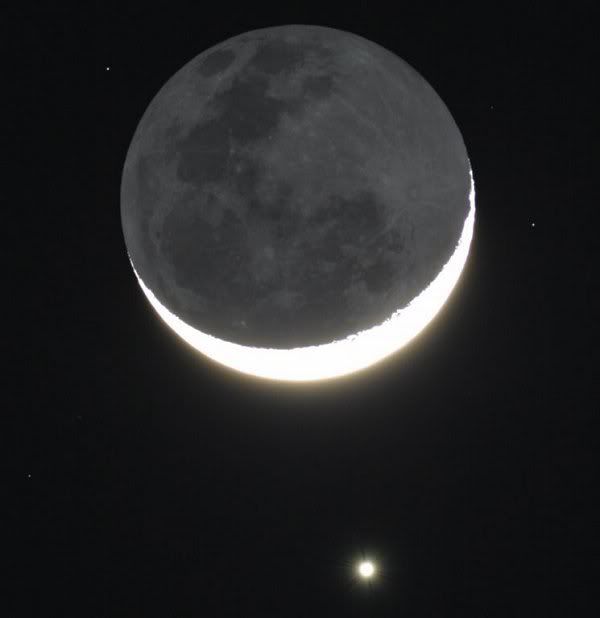
The heavenly orbs have been in my thoughts all week, as we've watched the convergence of the new moon and Venus. I'm working on a poem to express the wonder and majesty I've been observing.

This week's challenge: write a poem celebrating the sky. Planets, stars, asteroids, mythology, whatever strikes you as you gaze upward. Please share it with us in the comments!
Monday, May 14, 2007

Weekly Writing Challenge--The Sonnet

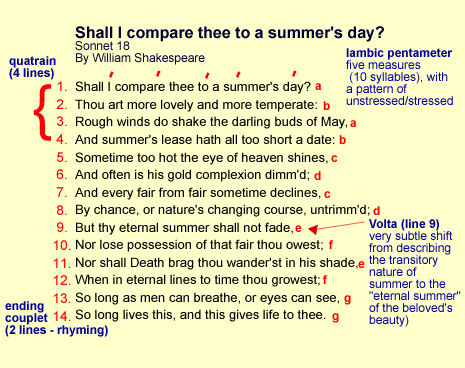
A sonnet is a fourteen-line poem in iambic pentameter with a carefully patterned rhyme scheme. The English or Shakespearean sonnet, developed first by Henry Howard, Earl of Surrey (1517-1547), consists of three quatrains and a couplet--that is, it rhymes abab cdcd efef gg. A very favorite and familiar sonnet is Shakespeare's "Shall I Compare Thee to a Summer's Day?" Observe the elements of this sonnet in the figure below: (click on the figure to see it more clearly)


Now try writing your own sonnet. Share your results with us in the comment section, or leave a link to your poetry blog. This week we'll be posting more information about the sonnet, and sharing some great examples of this form of poetry.